







Summarize With AI


Why taking breaks improves productivity isn't a soft, feel-good claim. It's backed by neuroscience research, a government safety agency, and a decade of workplace time-tracking data, and the mechanisms behind it are more specific than "everyone needs to relax sometimes."
We360.ai works with more than 120,000 users across 10,000-plus companies in 21-plus countries, and the pattern in that usage data lines up with the research: the people logging the most hours aren't always the ones shipping the most work. That gap is a big part of why taking breaks improves productivity even when it feels counterintuitive.
Why does taking Breaks Improve Productivity?
Taking breaks improves productivity because sustained attention isn't a fixed resource, it's a system that habituates to constant stimulation and needs periodic resets to keep functioning well. Without a break, your brain treats an ongoing task the way it treats background noise: present, but increasingly ignored.
Alejandro Lleras, a psychology professor at the University of Illinois, tested this directly. Participants worked on a 50-minute computer task, and one group took two brief mental diversions partway through. That group showed no drop in performance over the full 50 minutes, while other groups saw a clear decline, according to the University of Illinois News Bureau, with the research published in the journal Cognition.
What is vigilance decrement? Vigilance decrement is the well-documented drop in attention and accuracy that happens the longer someone stays on a single, unchanging task. Lleras's research suggests brief breaks interrupt this decline by forcing the brain to re-engage with its goal, which is the clearest mechanism behind why taking breaks improves productivity on long, repetitive tasks specifically.
What does the Research Actually say about Taking Breaks at Work?
The research on taking breaks at work points in one consistent direction: shorter, more frequent breaks tend to outperform working straight through, though the exact ideal ratio keeps shifting as work patterns change. The popular "52-17 rule" is the clearest example of that shift.
DeskTime, a time-tracking company, first identified the 52-17 pattern in 2014 by studying its own most productive users: 52 minutes of focused work followed by a 17-minute break. When the company repeated the study in 2021, the ratio had moved to 112 minutes of work and 26-minute breaks, a change DeskTime attributes largely to remote work habits formed during the pandemic, according to DeskTime's own follow-up analysis.
That shift matters more than the specific numbers. It confirms there's no single universal ratio, but it also confirms the underlying pattern holds: high performers still build real breaks into longer stretches of focused work, rather than skipping them to power through. Whatever the exact ratio, this is real-world evidence for the benefits of taking breaks at work among the people who track their own output most closely.
[Image: A graph comparing the original 52-17 work-break ratio to the updated 112-26 ratio - alt='statistics on taking breaks at work showing the updated 112 to 26 ratio']
Why am I better at something after taking a Break?
You're better at a skill after a break because your brain actively rehearses what you just practiced during the rest period, at a much faster speed than you performed it. This isn't idle downtime. It's active memory consolidation happening while you think you're doing nothing.
Researchers at the National Institutes of Health, led by senior investigator Dr. Leonardo Cohen, had 33 volunteers practice typing a five-digit code, then studied their brain activity during short rest periods between practice sessions. The brain replayed the typing sequence at roughly 20 times the original speed, up to 25 times per rest period during early learning, according to the NIH. Volunteers whose brains replayed the sequence more often showed the biggest performance gains afterward.
The replay activity showed up mainly in the brain's motor control regions, but also, unexpectedly, in the hippocampus, an area tied to memory formation. Study author Dr. Cohen described it as the brain "binding together the memories required to learn a new skill" during that quiet rest period, not just recovering from fatigue. It's one of the more direct, mechanistic answers to why taking breaks improves productivity on tasks you're actively learning.
How many Breaks should you have on a 7 Hour Shift?
For a 7-hour shift built around computer work, OSHA's own guidance points to roughly one short break per hour, plus a longer meal break, rather than one long break at the midpoint. OSHA's Computer Workstations eTool recommends taking "a five-minute break from computer tasks" every hour, along with looking away, stretching, or walking, according to OSHA.
Applied to a 7-hour shift, that works out to roughly six or seven short 5-minute micro-breaks spread through the day, on top of a standard meal break. OSHA doesn't mandate a single national rule for office break frequency the way some state labor laws do for meal breaks, but its own ergonomics guidance is consistent: frequent and short beats rare and long for screen-based work specifically, which is a practical, shift-length version of why taking breaks improves productivity for anyone at a desk all day.
Physically demanding or extended shifts need more than that. OSHA's guide for extended and unusual work shifts recommends "regular and frequent" breaks beyond standard meals, plus additional rest periods once a shift runs past the normal 8 hours, according to OSHA's extended shifts guide. That guidance is the closest thing to an official answer on how many breaks a shift actually needs, and it backs up why taking breaks improves productivity even in physically demanding jobs.
What Happens When you Skip Breaks?
Skipping breaks doesn't save time, it borrows it, and the debt usually shows up as more errors, slower work, and eventual burnout rather than as extra output. The vigilance decrement research above predicts exactly this: attention doesn't hold steady just because you refuse to stop, and that borrowed-time pattern is really why taking breaks improves productivity more than it costs it.
The pattern connects directly to broader research on low productivity. Burnout, workload strain, and constant task-switching are among the most consistently cited drivers behind what causes low productivity on a team, and skipped breaks feed all three at once. A "always on" culture that treats breaks as optional usually pays for it in rework, not in extra hours banked.
Here's the honest take: a break you feel too busy to take is usually the clearest sign you need one. The work waiting for you after a five-minute walk is rarely worse off than it would have been after another hour of declining focus, and that gap is exactly why taking breaks improves productivity more than skipping them ever does.
How do you Actually Build Breaks into a Busy Workday?
Building real breaks into a busy day works best as a scheduled habit, not a reaction to feeling exhausted, since waiting until you're depleted means the break arrives too late to prevent the dip. Treat break timing the same way you'd treat any other calendar commitment, since that's the practical, day-to-day version of why taking breaks improves productivity instead of staying a nice idea nobody schedules.
- Set an hourly reminder for a five-minute break, matching OSHA's own computer-work guidance, rather than relying on willpower to notice when you're fading.
- Leave your desk, physically. A break spent scrolling a different screen doesn't give your visual system or attention system the same reset as actually looking away.
- Protect a longer break mid-shift, not just short ones, since both the 52-17 and updated 112-26 patterns pair short work blocks with a genuinely longer recovery period.
- Treat break-skipping as a scheduling problem, the same way our guide to common time management myths treats an overpacked calendar: fix the schedule, don't just push through it.
Ready to see whether your team is actually taking the breaks its schedule allows—and whether the productivity benefits of taking breaks show up in your own usage data? Start a free trial to check real focus and break patterns this week, or book a demo to walk through it with us directly.
Why am I better at something after taking a break? +−
Your brain replays the skill you just practiced at roughly 20 times normal speed during short rest periods, according to NIH research led by Dr. Leonardo Cohen. That active replay is a big part of why taking breaks improves productivity on tasks you're still learning, since the break itself is doing memory work, not just resting.
How many breaks should you have on a 7 hour shift? +−
OSHA's guidance for computer-based work suggests a five-minute break roughly every hour, which works out to about six or seven short breaks across a 7-hour shift, plus a standard meal break. Physically demanding or extended shifts need additional rest periods beyond that.
What is the 52-17 rule, and does it still hold up? +−
It's a work-break ratio (52 minutes of work, 17-minute breaks) that DeskTime identified in 2014 among its most productive users. A 2021 follow-up found the ratio had shifted to 112 minutes of work and 26-minute breaks, so the specific numbers changed, but the underlying pattern of scheduled recovery time held up.
Do short breaks actually improve focus, or is that just an excuse to procrastinate? +−
They measurably improve it, which is a core part of why taking breaks improves productivity rather than just feeling nice. A University of Illinois study found people who took two brief mental breaks during a 50-minute task kept steady performance, while people who worked straight through showed a clear decline, consistent with how attention naturally habituates to unchanging tasks.
What's the difference between a break and just getting distracted? +−
A break is a deliberate pause with a start and end point, ideally away from a screen. Getting distracted is an unplanned interruption that often costs you the 25 minutes of refocus time research shows interruptions typically require, without the recovery benefit a real break provides.
Related Posts
What causes low productivity almost never comes down to one thing. Real Gallup, Microsoft, and Asana data on the actual drivers, from disengagement to meeting overload, and a five-step framework for fixing the ones on your team.
Understand digital presenteeism and why being constantly online does not always mean being productive. Explore how excessive availability, unnecessary meetings, notifications, and screen time can impact focus, employee well-being, and performance. Learn practical strategies to measure meaningful productivity, reduce digital overload, set healthy boundaries, and build more effective work environments.
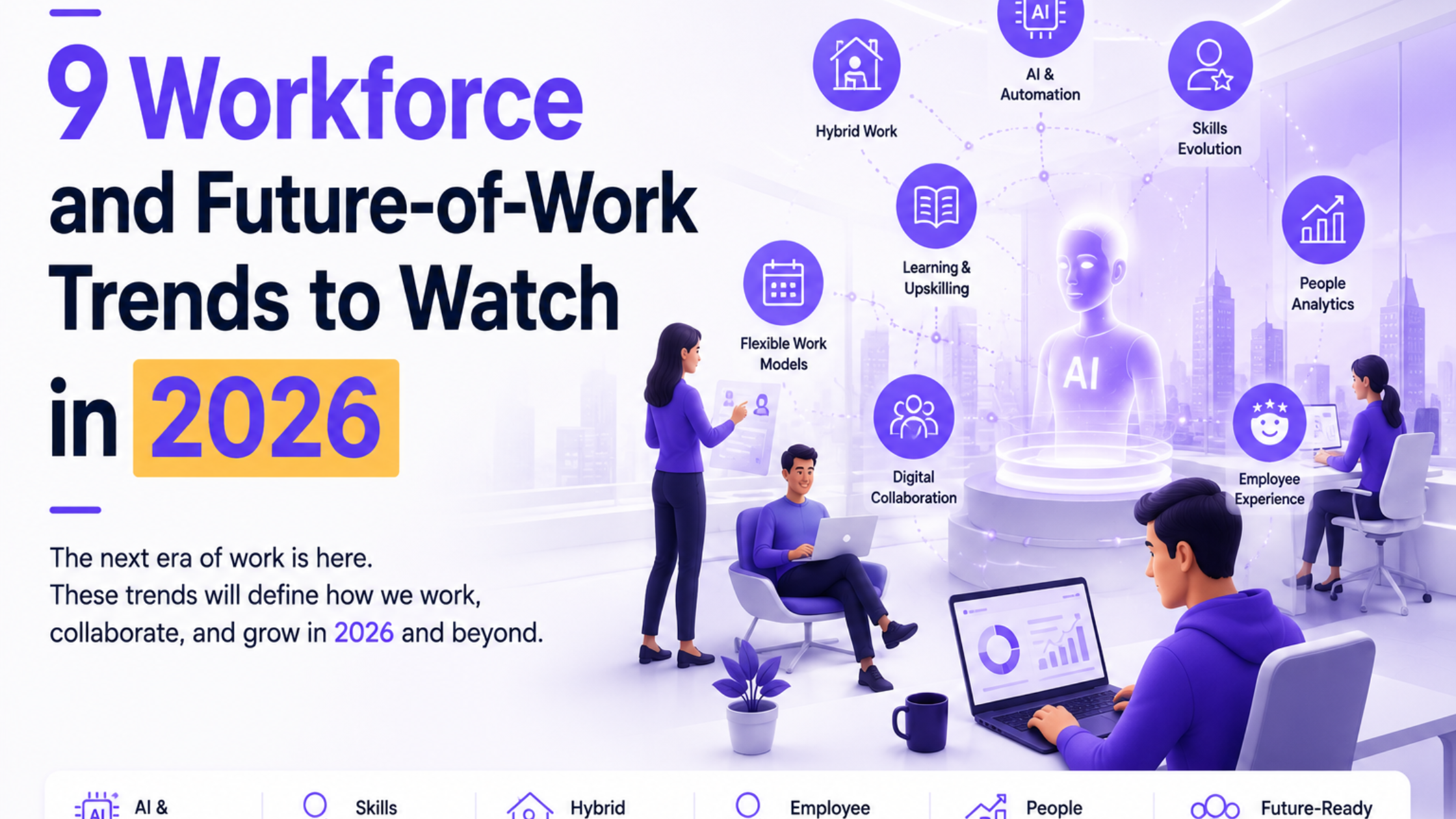
The future of work is changing rapidly in 2026. From AI agents becoming part of the workforce to evolving skills, hybrid work models, and outcome-based productivity, organizations must rethink how they manage people and performance. Explore the nine key workforce trends shaping the future of work and what leaders need to do to prepare.
Employee recognition is more than an occasional thank-you. Learn how structured recognition programs improve retention, reduce burnout, and create a stronger workplace culture.