

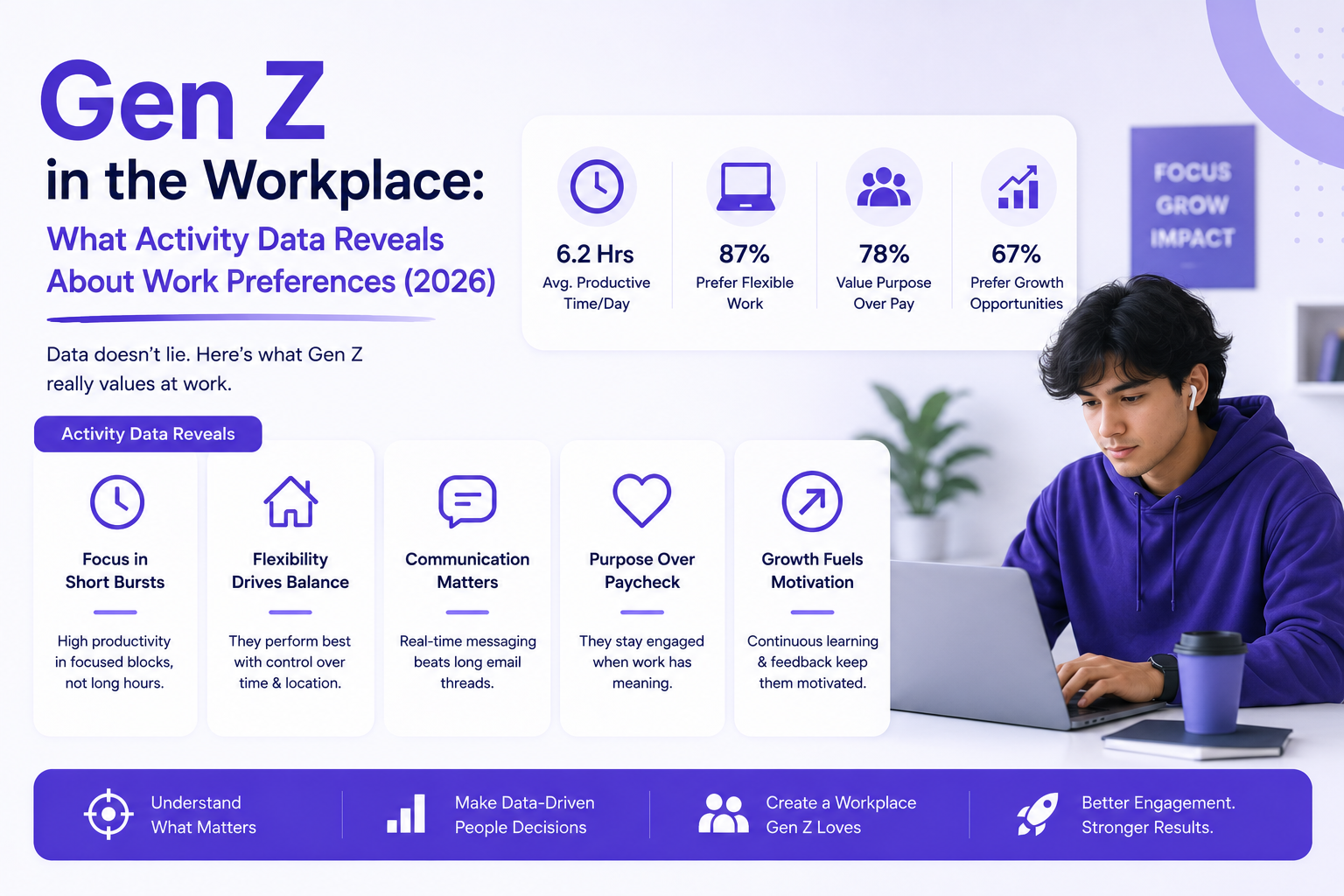
Gen Z often gets labelled "hard to manage," but workplace data can tell a more nuanced story than office gossip. Their approach to work is increasingly shaped by technology, flexibility, learning, and well-being, not a lack of ambition.
74% of Gen Z respondents say they use AI in their day-to-day work, according to Deloitte's 2026 Gen Z and Millennial Survey.
Looking at activity patterns alongside employee feedback can reveal how work is actually getting done, helping managers move beyond generational stereotypes and make better decisions based on evidence.
Why Gen Z Work Habits Keep Getting Misread
Most assumptions about Gen Z at work come from anecdotes: someone checks Slack frequently, switches between apps, prefers a quick message over a meeting, or works outside traditional hours. These behaviours can easily be interpreted as distraction or disengagement when viewed in isolation.
Workplace activity data offers a broader picture. Instead of focusing on one behaviour, managers can look at patterns across tools, working hours, task completion, learning activity, and collaboration. This doesn't prove that every Gen Z employee works in the same way. Still, it can help explain why traditional measures of productivity may not always capture how younger employees contribute.
This doesn't prove that every Gen Z employee works in the same way. However, it can explain why traditional productivity measures may not always capture how younger employees contribute.
Pattern #1: Shorter, More Frequent Focus Blocks
Moving between a project management tool, a document, a communication platform, and research sources can be part of completing a task rather than a sign of distraction.
An activity log may show frequent transitions while the employee is still making meaningful progress.
For managers, the focus should be on the outcomes surrounding those transitions, such as task completion, meeting deadlines, and maintaining consistent productive activity throughout the day.
In a technology-heavy workplace, shorter work cycles can also reflect the nature of modern jobs, where employees constantly move between information, communication, and execution.
Microsoft's Work Trend Index found that 68% of people don't have enough uninterrupted focus time during the workday, while the average employee spends 57% of their time communicating through meetings, email, and chat.
This suggests that frequent digital activity should not automatically be mistaken for distraction. Managers need context before concluding.
Pattern #2: Flexible Hours, Not Fewer Hours
The traditional 9-to-5 schedule is no longer the only way work gets done. Activity timestamps can reveal work happening earlier in the morning, later in the evening, or around other personal commitments. For Gen Z employees, this may reflect a preference for flexibility rather than a preference for working less.
While learning activity is not the same as job activity, the finding highlights a broader willingness among Gen Z to engage with work-related development beyond conventional schedules.
The focus should therefore be on outcomes and sustainable performance, not simply whether someone is online from 9 to 5.
A manager looking only at office hours may miss productive work happening outside them. At the same time, activity data should not be used to encourage employees to work longer or blur healthy boundaries. The focus should therefore be on outcomes and sustainable performance, not simply whether someone is online from 9 to 5.
Pattern #3: Tool-Heavy, Async-First Collaboration
Gen Z entered the workforce surrounded by digital communication tools. For many, sending a message, commenting on a document, updating a dashboard, or sharing information asynchronously can feel more natural than scheduling another meeting.
Activity data can help managers understand this shift by showing how employees collaborate across communication platforms, shared documents, project management systems, and other digital tools. A lower meeting count does not automatically mean lower collaboration.
In fact, excessive digital communication can have its own downsides. Many Gen Zers face digital fatigue caused by constant alerts, tool switching, and multiple platforms.
This creates an important management lesson: the goal shouldn't be to maximise activity across every tool. It should be to understand which channels help employees communicate effectively and which create unnecessary noise.
Pattern #4: High Activity Around Learning and Upskilling Tools
Learning activity is one of the clearest signals of what Gen Z values at work. Time spent on internal learning platforms, training modules, documentation, or professional development resources can indicate that employees are actively building skills rather than simply completing assigned tasks.
According to LinkedIn Learning's 2025 Workplace Learning Report, career progress is the No. 1 motivation for employees to learn, highlighting the strong connection between skill development and career growth.
For managers, these patterns can offer useful insights into engagement and retention. If employees consistently seek learning opportunities but have limited access to development, the issue may be less about motivation and more about whether the organisation is providing enough growth opportunities.
Activity data can help identify which resources employees use most, allowing businesses to invest in learning that aligns with actual behaviour.
Pattern #5: Recognition and Engagement Signals
Employee engagement is difficult to measure through activity data alone. A drop in logins, task completion, or collaboration can have many explanations, from changing workloads to holidays or project transitions. It should never automatically be treated as proof of disengagement.
However, activity trends can become useful when combined with other signals. A sustained change in work patterns, especially alongside missed deadlines, reduced collaboration, or declining participation, may indicate that a manager should check in with the employee.
Rather than waiting for performance to decline significantly, managers can use activity trends as a prompt for conversation. The objective isn't to monitor every click but to spot changes early and understand what support an employee may need.
What This Means for Managing Gen Z Teams
The data points to a simple conclusion: managing Gen Z effectively is less about enforcing one definition of productivity and more about understanding how work gets done.
Flexibility can support sustainable performance, learning opportunities can strengthen engagement, Async tools can reduce unnecessary meetings, and recognition and mentorship can help employees see a future within the organisation.
Workplace analytics platforms such as We360.ai can help managers bring activity and productivity information into one view, making it easier to identify patterns over time. Used responsibly, this data can support evidence-based management without turning the workplace into a surveillance system.
The goal is to understand trends, not track every move.
FAQs
Is Gen Z really less productive than older generations?
There is no simple evidence that Gen Z is inherently less productive. Differences in communication styles, technology use, and work preferences can sometimes be mistaken for lower productivity. Managers should evaluate outcomes, quality, and completed work rather than relying on stereotypes or isolated activity metrics.
Does activity data show Gen Z prefers remote work?
Activity data alone cannot prove that an entire generation prefers remote work. However, flexibility is an important workplace consideration for many Gen Z employees. Data can help organisations understand how teams perform across different working arrangements, but employee surveys and feedback are also needed to understand individual preferences.
How can companies use this data without feeling like surveillance?
Transparency is essential. Employees should know what information is collected, why it is collected, and how it will be used. Companies should focus on aggregated trends, productivity insights, and outcomes rather than monitoring every individual action. Activity data works best as a management tool that supports employees, not as a mechanism for constant surveillance.
What's the biggest data-backed misconception about Gen Z at work?
One of the biggest misconceptions is that Gen Z's preference for flexibility, technology, and different communication styles reflects a lack of ambition. Research suggests otherwise. According to Deloitte's 2025 Gen Z and Millennial Survey, 70% of Gen Z respondents develop career skills at least weekly, highlighting a strong focus on continuous growth and development.
Conclusion
Gen Z isn't necessarily harder to manage; the bigger challenge is understanding what productivity looks like in a rapidly changing workplace. Assumptions can only take managers so far. The right data, viewed in context, can reveal patterns that help leaders support their teams more effectively.
With We360.ai, businesses can turn workforce activity data into meaningful productivity insights, helping managers make more informed decisions while building a culture based on transparency and trust.
Explore how we can help you better understand your workforce and manage productivity with greater clarity.
.png)