
Burnout doesn’t usually show up as a dramatic breakdown. It shows up as a slightly later reply, a skipped stand-up, a slower first commit of the day. By the time it’s obvious, it’s usually already cost you weeks of productivity — or a resignation letter.
The scale of the problem is bigger than most managers realize. Research from Mercer found that 82% of employees are at risk of burnout, yet fewer than half of employers have redesigned work around wellness priorities. Separately, workplace studies show 55% of the U.S. workforce is currently experiencing burnout, with the number climbing to 61% among fully remote employees. Manager engagement has also slipped to just 27% globally — even though managers account for an estimated 70% of the variance in team engagement. In other words, the people best positioned to catch burnout early are often the ones missing it.
The financial cost is significant too: burnout is estimated to cost employers between $3,999 and $20,683 per employee annually, and 89% of that cost comes from presenteeism — people physically present but mentally checked out — rather than absenteeism. That’s the trap. Burnout hides in plain sight, inside people who are technically “at work.”
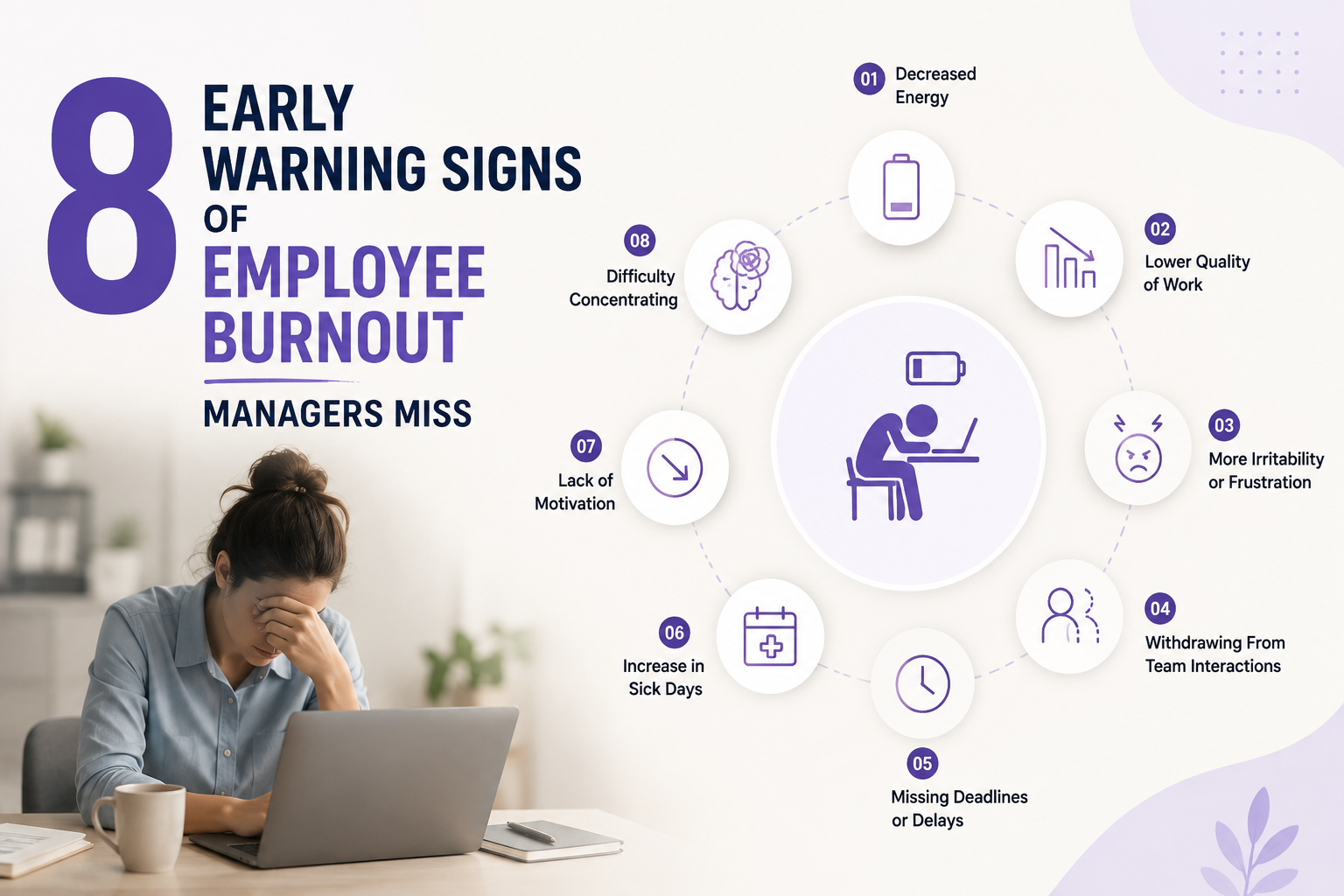
Here are the eight signs that tend to slip past even attentive managers, and what to watch for instead.
1. A Quiet Drop in Output, Not a Dramatic One
Classic burnout narratives expect a visible collapse. In reality, the first sign is almost always a gradual, easy-to-rationalize decline: slightly fewer tasks closed per week, slightly longer time-to-first-response, a project that used to take three days now taking five. Individually, none of these look alarming. Tracked over four to six weeks, the trend line tells a very different story. Managers relying on gut feel or weekly check-ins miss this because they’re comparing “today” to “yesterday,” not to a baseline from a month ago.
What to do instead: Look at productivity trends over rolling windows, not single days. A consistent downward slope over several weeks is a far stronger signal than any one bad day.
2. Working Longer Hours While Producing Less
This is the sign managers most often read backwards. An employee logging in earlier, staying later, and appearing “committed” is frequently in the early-to-mid stages of burnout, not thriving. Extended hours combined with flat or declining output is one of the clearest behavioral fingerprints of burnout — the person is spending more time to achieve the same or less, because focus, decision-making speed, and error-checking all degrade under chronic stress.
What to do instead: Pair hours-worked data with output data. Rising hours plus flat output is a warning sign, not a productivity win.
3. Disengagement From Non-Mandatory Interactions
Burnout tends to shrink a person’s world before it shrinks their task list. The first casualties are usually optional: skipping the informal Friday chat, muting notifications outside of core hours, going silent in group channels while still replying to direct requests. Because none of these are “required” work, they’re easy for a manager to miss entirely — nobody flags an absence from a conversation that was never mandatory in the first place.
What to do instead: Notice changes in voluntary engagement — team channels, optional meetings, peer-to-peer messages — not just task completion.
4. A Spike in “Small” Errors
Burnout impairs working memory and attention to detail well before it affects someone’s ability to complete tasks at all. That shows up as an uptick in minor, previously rare mistakes: typos in reports, missed CC’s, small logic errors in code, duplicate entries. Each one is trivial. A cluster of them from someone who was previously meticulous is not.
What to do instead: Track error rates and rework, not just completion rates. A rising rework rate from a consistently strong performer deserves a conversation, not a performance flag.
5. Irregular or Shifting Work Hours
People managing burnout often start working at unusual times — very early, very late, or in scattered bursts throughout the day — as they try to find windows when they can concentrate, or as sleep disruption (a well-documented burnout symptom) reshapes their schedule. This is easy to miss in hybrid and remote teams where “when” someone works is already loosely tracked.
What to do instead: Watch for a shift in someone’s usual working pattern — not the hours themselves, but the change from their personal baseline.
6. Reduced Participation in Career-Growth Conversations
One of the most reliable predictors of attrition — and a close cousin of burnout — is disengagement from career development. Data on turnover consistently shows that a lack of growth opportunity is among the top reasons people leave, and burned-out employees often stop asking for stretch projects, skip optional training, or go quiet in 1:1s about where they see themselves in a year. It’s a subtle withdrawal that reads as “low ambition” when it’s often “no capacity left.”
What to do instead: Treat a sudden lack of interest in growth conversations from a previously ambitious employee as a signal worth exploring directly, not a personality shift to accept at face value.
7. Belonging Signals Quietly Eroding
Workplace research shows a stark gap here: employees who feel a strong sense of belonging report burnout at roughly 55%, compared to 78% among those who don’t feel they belong. Belonging often erodes before performance does — someone stops sitting with the team at lunch, turns their camera off more often, or stops volunteering opinions in meetings they used to contribute to freely.
What to do instead: Pay attention to social integration signals, not just work output. A drop in informal participation is often the earliest available data point you have.
8. The Generational Timing Gap
Burnout doesn’t hit every employee on the same schedule. Research shows Gen Z employees tend to peak in burnout risk around age 25 — roughly 17 years earlier than the average American’s peak burnout age of 42. Managers calibrated to expect burnout in senior, tenured staff can easily miss it in younger employees who are, on paper, “too early in their career” to be burned out.
What to do instead: Don’t apply a one-size-fits-all mental model of who’s “due” for burnout. Younger employees can hit the wall just as hard, often earlier than expected.
Why This Is Hard to Catch Manually
The common thread across all eight signs is that none of them are dramatic enough to trigger a conversation on their own. They’re only visible as patterns over time, and most managers don’t have a systematic way to track patterns — they have a memory of last week’s stand-up and a gut feeling.
This is exactly the gap workforce analytics platforms are built to close. Tools like We360.ai continuously track activity trends, working-hour patterns, and engagement signals across a team, then surface deviations from an individual’s own baseline — not a generic benchmark. Instead of a manager trying to remember whether someone’s hours crept up over six weeks, the system flags it. Instead of guessing whether a dip in output is a bad week or a trend, the data makes the call.
Turning Early Signals Into Early Action
Catching burnout early isn’t about surveillance — it’s about giving managers the same kind of leading indicators that finance teams get from a dashboard, instead of relying on someone to notice a slow decline in real time across ten or twenty direct reports simultaneously. The cost of missing these signals is measured in resignations, quality slippage, and — increasingly — direct dollars, given that turnover now costs employers upwards of $45,000 per departing employee in 2026 estimates.
The eight signs above rarely arrive one at a time. They tend to compound: hours creep up, output dips, participation quietly shrinks, and by the time it’s visible to the naked eye, the employee has often already mentally checked out. Building a habit — whether through structured 1:1 questions, regular pulse surveys, or workforce analytics that flag deviations automatically — of looking for these signals early is the difference between a course correction and a resignation letter.
Key Takeaways
- Burnout signals are almost always behavioral before they’re emotional — output trends, working-hour shifts, and participation changes precede any verbal complaint.
- 82% of employees are estimated to be at burnout risk, yet manager engagement sits at just 27% globally, creating a detection gap most organizations haven’t closed.
- The financial impact — $3,999 to $20,683 per employee annually — comes mostly from presenteeism, meaning the cost accrues silently long before anyone resigns.
- None of the eight signs are individually alarming; they only become meaningful as trends tracked over weeks, which is why manual, memory-based tracking consistently misses them.
- Younger employees are not exempt — Gen Z’s burnout risk peaks around age 25, well before the average peak age of 42, so risk assessments shouldn’t be calibrated only to senior staff.
Frequently Asked Questions
What is the earliest sign of employee burnout? Behavioral change is almost always earlier than emotional change. A quiet, gradual drop in output or a subtle shift in working hours typically shows up weeks before an employee says anything about feeling burned out, or before it affects visible work quality. Managers who wait for someone to say “I’m burned out” are usually acting on the fourth or fifth signal, not the first.
Can burnout be reversed once it starts? Yes, especially when caught in the early stages described above. Reversal typically requires reducing workload temporarily, restoring a sense of autonomy or control, and — critically — following up to confirm the change actually happened, rather than a one-time conversation. Burnout caught at the “quiet disengagement” stage is far easier to reverse than burnout caught at the resignation stage.
How is burnout different from ordinary work stress? Stress is typically episodic and tied to a specific deadline or event; it resolves once the event passes. Burnout is chronic and doesn’t resolve on its own even after the triggering project ends — it shows up as a sustained pattern across weeks or months, which is exactly why trend-based tracking catches it better than a single check-in.
Does remote work make burnout harder to detect? Yes. Fully remote employees report burnout at 61%, compared to 55% across the broader workforce, and the physical distance removes many of the informal visual cues — tiredness, mood, body language — that managers rely on in person. This is one of the reasons behavioral and activity-trend data has become a more important detection tool for distributed teams specifically.
Sources: Mercer 2026 workplace risk data; WorkTime 2026 burnout statistics report; Forbes, “Why Employee Turnover Is A Bigger Business Risk In 2026” (April 2026); Gitnux Call Center Attrition Statistics 2026.