

Most businesses don’t fail because they lack effort. They fail because they’re measuring the wrong things or, worse, not measuring at all.
That’s where benchmarking in management quietly becomes one of the most powerful growth levers. While companies obsess over new tools, trends, and strategies, the smartest ones are doing something far simpler. They’re comparing, analyzing, and improving based on real performance data.
Benchmarking isn’t just about looking at competitors. It’s about understanding where you stand, what “good” actually looks like, and how far you are from it. Without that clarity, decisions become guesswork, goals become vague, and growth becomes inconsistent.
In practical terms, benchmarking in management means evaluating your business performance against internal standards, industry benchmarks, or top competitors. It gives you a clear reference point. Not opinions. Not assumptions. Actual, measurable insight.
And here’s the truth most companies overlook: You can’t improve what you don’t accurately compare.
Whether it’s productivity, operational efficiency, employee performance, or cost management, performance benchmarking shows you exactly where you’re winning and where you’re falling behind. It turns raw data into direction.
In a business environment that’s moving faster than ever, relying on instinct alone is no longer enough. Companies that consistently grow are the ones that build systems around data, accountability, and continuous improvement.
That’s exactly what benchmarking enables.
What is Benchmarking in Management? (And Why It Matters Today)
At its core, benchmarking in management is the process of comparing your business performance against a defined standard. That standard could be your past performance, industry averages, or top-performing competitors.
It sounds simple, but the impact is anything but.
Instead of operating on assumptions, benchmarking gives you a clear, data-backed view of how your business is actually performing. You’re not just asking, “Are we doing well?” You’re asking, “How do we measure up against the best, and what do we need to do to get there?”
This is where the real value lies.
The importance of benchmarking comes down to clarity and direction. Without it, teams often set goals based on internal expectations rather than real-world performance. That leads to either underperformance or unrealistic targets that burn people out.
With benchmarking, you create context. For example:
- Is your team’s productivity truly low, or just average for your industry?
- Are your operational costs high, or actually optimized compared to competitors?
- Is your growth slow, or aligned with market trends?
These are questions benchmarking answers with precision.
More importantly, business benchmarking helps shift decision-making from reactive to strategic. Instead of fixing problems after they appear, you start identifying gaps early and improving proactively.
In today’s environment, where hybrid work, global competition, and rapid digital transformation are the norm, relying on internal data alone is risky. Companies that win are the ones that continuously compare, adapt, and refine.
In simple terms, benchmarking turns performance into something you can track, improve, and scale consistently.
Why Business Benchmarking is Non-Negotiable in 2026
Business has changed. Faster cycles, distributed teams, and constant competition mean there’s very little room for guesswork anymore.
What worked even two years ago can quickly become outdated. Markets shift, employee expectations evolve, and productivity patterns are no longer predictable. In this kind of environment, relying on intuition or outdated metrics puts companies at a serious disadvantage.
This is exactly why business benchmarking is no longer optional. It’s a core part of staying relevant.
Eliminates Guesswork
Without benchmarking, most decisions are based on assumptions. Leaders estimate performance instead of measuring it against real standards.
Performance benchmarking removes that uncertainty. It gives you concrete data to answer critical questions:
- Are your teams performing at the right level?
- Are your processes efficient compared to industry norms?
- Are you improving or just maintaining?
Instead of debating opinions, you work with facts. That alone speeds up decision-making and reduces costly mistakes.
Enables Competitive Positioning
You can’t compete effectively if you don’t know where you stand.
Benchmarking helps you understand how your business compares to others in your space. It highlights where you’re ahead and where competitors are outperforming you.
This insight is key for positioning. Whether it’s pricing, service quality, delivery speed, or innovation, benchmarking shows you what “competitive” actually looks like and how to get there.
Drives Accountability
One of the biggest hidden benefits of benchmarking is accountability.
When clear performance benchmarks are in place, expectations become measurable. Teams know what success looks like, and leaders can track progress objectively.
There’s no ambiguity. No moving goalposts.
This creates a culture where performance is transparent, improvements are continuous, and results are owned across the organization.
Types of Benchmarking Every Business Should Use
Not all benchmarking is the same. Different situations call for different approaches, and relying on just one type limits what you can learn.
The most effective companies use a mix of benchmarking techniques to get a complete view of their performance. Each type answers a different question and together, they create a full picture of where you stand and where you need to improve.
Here are the four essential types of business benchmarking every company should be using:
Internal Benchmarking
Internal benchmarking compares performance across teams, departments, or time periods within your own organization.
For example, you might compare:
- Productivity between two teams
- Performance across different locations
- Current results vs past performance
This is often the easiest place to start because the data is already available. It helps you identify what’s working internally and replicate success across the organization.
It also creates a baseline, which is critical before you start comparing yourself externally.
External Benchmarking
External benchmarking looks outward. It compares your performance with competitors or industry standards.
This is where you get real market context.
You begin to understand:
- What top performers are doing differently
- Where your business stands in the industry
- What “good” actually looks like outside your company
External benchmarking is essential for staying competitive. Without it, you risk optimizing internally while still falling behind in the market.
Performance Benchmarking
Performance benchmarking focuses on specific metrics or KPIs such as productivity, efficiency, revenue per employee, or turnaround time.
It answers one key question:
How well are we performing in measurable terms?
This type of benchmarking is highly data-driven and is often used to track progress over time. It helps teams stay aligned with clear targets and ensures that improvements are measurable, not subjective.
Process Benchmarking
Process benchmarking goes deeper. Instead of just looking at results, it analyzes how the work gets done.
You examine workflows, systems, and operations to identify inefficiencies and improvement opportunities.
For example:
- How long does it take to complete a task from start to finish?
- Where are delays or bottlenecks happening?
- How do top-performing teams execute the same process?
This type of benchmarking is critical for long-term improvement because better processes lead to better outcomes.
What are the 7 Steps of Benchmarking Strategies That Actually Work
Benchmarking only delivers results when it’s done with structure and intent. Random comparisons won’t move the needle. What you need is a clear system that turns data into action.
These seven steps form benchmarking strategies that actually improve performance, not just report on it.
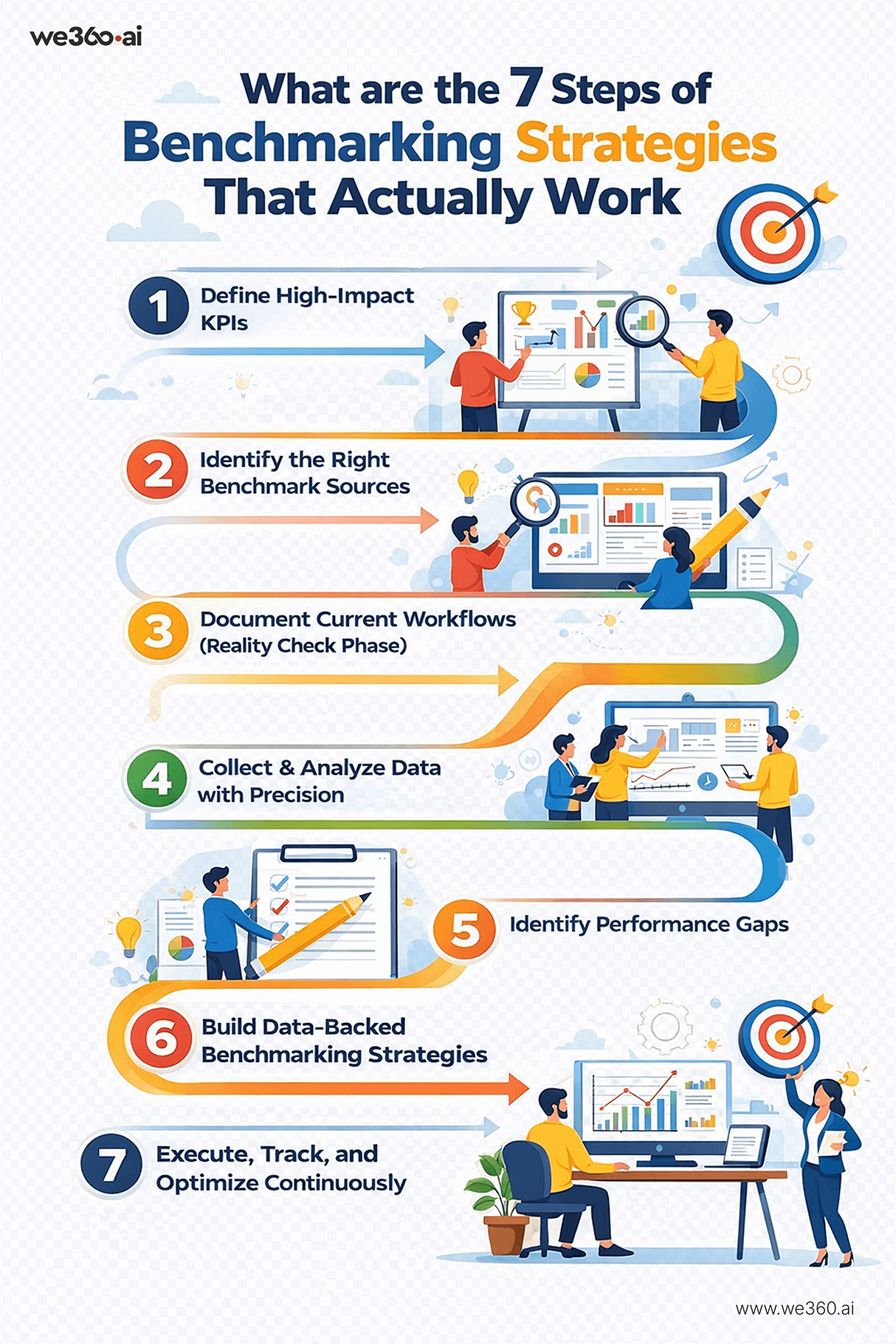
1. Define High-Impact KPIs
Start with what truly matters.
Not every metric deserves attention. Focus on KPIs that directly impact business outcomes such as productivity, revenue per employee, turnaround time, or customer satisfaction.
Strong performance benchmarks begin with relevant KPIs. If you measure the wrong things, even perfect benchmarking won’t help.
2. Identify the Right Benchmark Sources
Next, decide what you’re comparing against.
This could include:
- Internal historical data
- Industry standards
- Competitor performance
- Market leaders
The key is relevance. Comparing your business to the wrong benchmark leads to misleading conclusions.
3. Document Current Workflows (Reality Check Phase)
Before improving anything, you need a clear picture of how things currently work.
Map out your processes as they actually happen, not how they’re supposed to happen. This step often reveals hidden inefficiencies, delays, or duplicated efforts.
Think of this as your baseline. Without it, you won’t know what needs fixing.
4. Collect & Analyze Data with Precision
Now comes the data.
Gather accurate, consistent, and up-to-date information across your chosen KPIs. Then analyze it carefully to identify patterns, trends, and performance levels.
This is where performance benchmarking becomes powerful. You’re turning raw numbers into meaningful insights.
5. Identify Performance Gaps
Once you have the data, compare it against your benchmarks.
Where are you falling short?
Where are you ahead?
Where is performance inconsistent?
These gaps highlight exactly where improvement is needed. They remove ambiguity and give you a clear focus.
6. Build Data-Backed Benchmarking Strategies
With gaps identified, it’s time to act.
Develop targeted strategies to close those gaps. This could involve:
- Process improvements
- Resource reallocation
- Training and development
- Technology adoption
The key here is that your decisions are based on data, not assumptions.
7. Execute, Track, and Optimize Continuously
Benchmarking is not a one-time project. It’s an ongoing cycle.
Implement your strategies, track results against your benchmarks, and refine as needed. Continuous monitoring ensures that improvements are sustained and adapted as conditions change.
This is what separates high-performing organizations from the rest. They don’t just benchmark once. They build it into how they operate.
Top Advantages of Benchmarking for Business Performance
When done right, benchmarking doesn’t just tell you where you stand. It actively improves how your business operates.
The real advantages of benchmarking show up in day-to-day performance, decision-making, and long-term growth. It creates a system where improvement is not occasional, but continuous.
Here’s how it directly impacts business performance:
Improves Operational Efficiency
Benchmarking highlights inefficiencies that are easy to miss internally.
By comparing processes and outcomes, you can spot delays, redundancies, and unnecessary steps. This allows you to streamline operations and get more done with the same or fewer resources.
Over time, even small improvements here create significant gains.
Enhances Productivity Across Teams
When clear performance benchmarks are in place, teams know exactly what is expected.
There’s no confusion about targets or standards. Employees can measure their own performance and adjust in real time.
This clarity naturally drives higher productivity without constant supervision.
Elevates Work Quality
Benchmarking doesn’t just focus on speed or output. It also improves quality.
By comparing against top performers or industry standards, you raise the bar for what “good work” looks like. Teams begin to focus not just on completing tasks, but on doing them well.
This leads to better customer outcomes and stronger brand trust.
Reduces Operational Costs
Inefficiencies are expensive. Benchmarking helps you find and eliminate them.
Whether it’s wasted time, duplicated efforts, or underutilized resources, identifying these gaps allows you to cut costs without compromising performance.
In many cases, companies see cost savings simply by optimizing what they already have.
Strengthens Competitive Positioning
You can’t improve your position in the market if you don’t understand it.
Business benchmarking gives you visibility into how competitors and industry leaders operate. This helps you identify areas where you can differentiate and where you need to catch up.
It turns competition into a clear, measurable challenge rather than a vague threat.
Enables Smarter Goal Setting
Without benchmarks, goals are often arbitrary.
With benchmarking, targets are grounded in reality. You’re not guessing what’s achievable. You’re setting goals based on proven performance levels.
This leads to more realistic planning and better execution.
Drives Innovation and Scalable Growth
One of the overlooked benefits of benchmarking is how it encourages innovation.
When you study top performers, you uncover new ways of working. This pushes teams to rethink processes, adopt better tools, and experiment with smarter approaches.
Over time, these improvements compound, creating scalable growth.
In simple terms, the importance of benchmarking lies in its ability to turn insight into action. It connects data with decisions and decisions with results.
Companies that consistently apply benchmarking don’t just improve once. They build a system for ongoing performance optimization.
Benchmarking in Strategic Management
Benchmarking is not just an operational tool. It plays a critical role in shaping long-term direction. When used correctly, benchmarking in strategic management helps leaders make smarter, more confident decisions about the future of the business.
At a strategic level, benchmarking answers a deeper question:
Where should we be, and how do we get there?
Market Positioning
Benchmarking gives leaders a clear view of where the company stands in the market.
Instead of relying on perception, you get data-driven insight into how your pricing, performance, service quality, and efficiency compare to competitors. This helps define a realistic and competitive market position.
Expansion Planning
Growth without benchmarks is risky.
Whether entering a new market or scaling operations, benchmarking helps assess readiness. You can evaluate whether your current performance levels match what’s required to succeed in a new environment.
It reduces uncertainty and helps prioritize the right opportunities.
Resource Allocation
Every business has limited resources. The question is where to invest them.
Benchmarking highlights high-impact areas that need attention. Instead of spreading resources thin, leaders can focus on closing the most critical performance gaps.
This leads to better ROI and more efficient scaling.
In short, benchmarking in strategic management connects daily performance with long-term vision. It ensures that growth is intentional, measurable, and sustainable.
How we360.ai Enables Smarter Benchmarking and Performance Optimization
Benchmarking is only as effective as the data and tools behind it. This is where platforms like we360.ai simplify and strengthen the entire process.
Instead of manually tracking productivity, businesses can rely on real-time insights and automated analysis to make faster decisions.
Real-Time Workforce Analytics
we360.ai provides live visibility into how teams are working with the workforce analytics software.
You can track productivity, activity levels, and performance trends without delays. This makes performance benchmarking more accurate and actionable.
Performance Benchmarking Made Simple
The platform allows businesses to set clear performance benchmarks and compare them across teams, roles, and time periods.
This removes complexity and makes benchmarking accessible even for non-technical teams.
Data-Driven Decision Making
With detailed analytics, leaders can move away from assumptions.
Every decision, whether operational or strategic, is backed by real data. This strengthens overall benchmarking strategies and reduces risk.
Identify Productivity Gaps Instantly
One of the biggest challenges in business is spotting problems early.
We360.ai helps identify productivity gaps in real time, allowing managers to take corrective action before issues escalate.
Related read: Insightful Alternative: A Better Way to Track Team Productivity With We360.ai
Continuous Monitoring for Continuous Improvement
Benchmarking is not a one-time task.
The platform supports ongoing tracking and optimization, ensuring that improvements are sustained and performance keeps evolving.
If you want to turn benchmarking into a real competitive advantage, it starts with the right tools. Explore how we360.ai can help you track, compare, and improve performance continuously.
Conclusion
Most companies think growth comes from doing more. In reality, it comes from doing things better and knowing exactly what “better” looks like.
That’s what benchmarking delivers.
From improving daily operations to guiding long-term strategy, benchmarking in management creates clarity, accountability, and direction. It replaces guesswork with data and turns performance into something you can consistently improve.
The businesses that win are not the ones working the hardest. They’re the ones measuring, comparing, and optimizing continuously.
If you’re serious about growth, benchmarking isn’t optional. It’s essential.