
Why managing an Indian workforce manually doesn’t scale
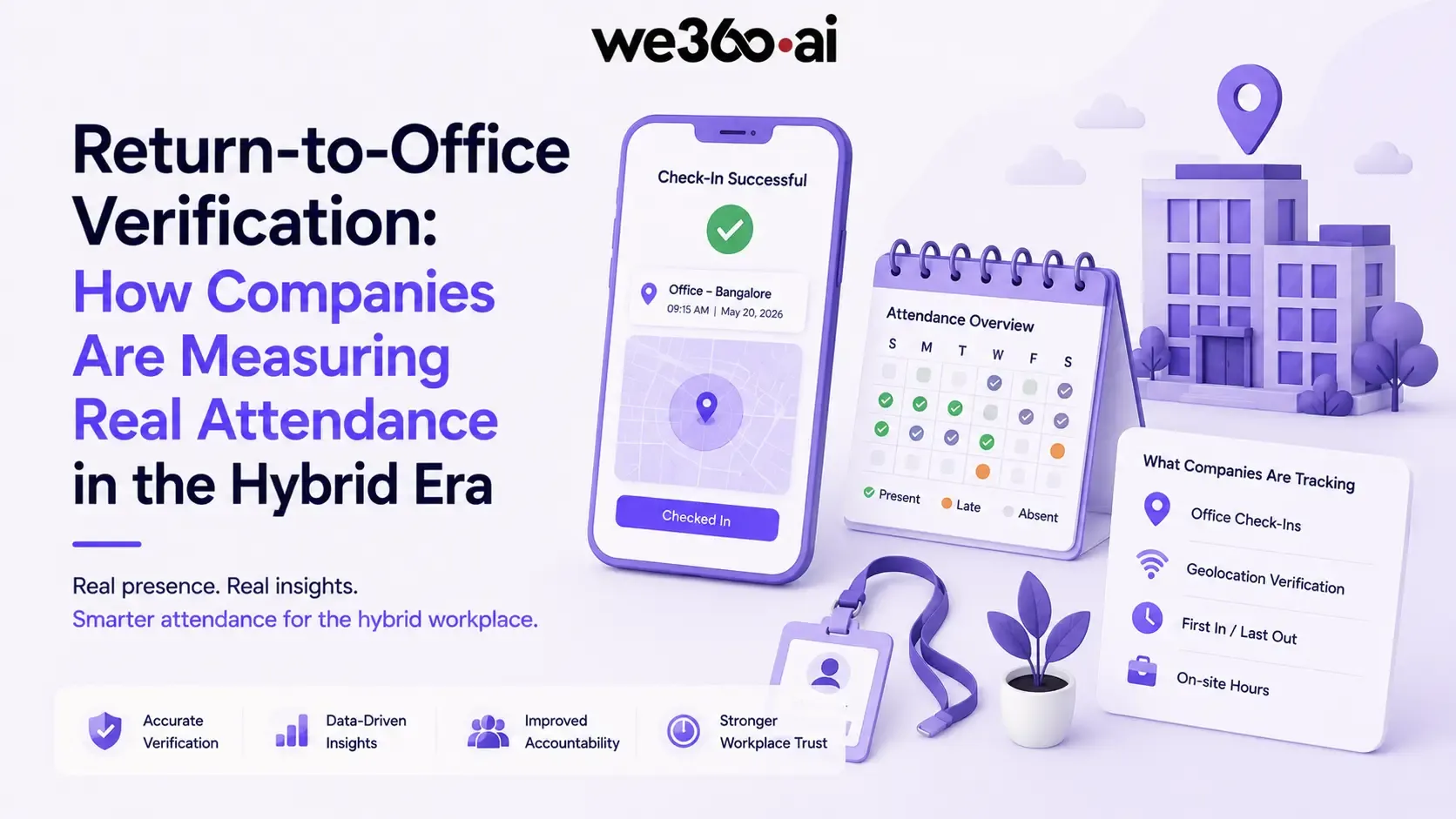
- Attendance registers and WhatsApp check-ins break the moment a team crosses 50 people or two cities.
- Managers guess at productivity because there is no objective record of focused work versus idle hours.
- Field staff in sales, logistics, and BFSI submit unverifiable visit reports, and payroll leaks follow.
- Compliance teams cannot prove on demand that monitoring respects the IT Act, 2000, and the DPDP Act, 2023.
- Hybrid and WFH employees fall off the radar, and attrition signals are caught only after the resignation.
How We360.ai solves this
We360.ai replaces guesswork with a single source of truth for workforce activity. Operations and HR leaders get real-time visibility into attendance, applications, websites, and field locations without playing detective. The platform is built India-first, with consent prompts, role-based access, and audit logs that map cleanly to local regulations.
The product is modular. Start with workforce analytics for desk teams, layer in field force tracking for sales and service staff, and connect payroll, HRMS, and project tools through native integrations. Implementation typically takes three to seven working days.
The outcome is measurable. Customers report 11 to 18% productivity uplift in the first quarter and 6 to 9% payroll savings from accurate timesheets. That is the ROI lens this page is written through.
What employee monitoring software India does
The legal landscape in India
- The Information Technology Act, 2000 permits workplace monitoring on employer-owned assets when employees are informed in writing.
- The Digital Personal Data Protection Act, 2023 (DPDP) requires a clear consent notice in English and the employee’s preferred language.
- Monitoring must be proportionate to a legitimate business purpose such as productivity, security, or attendance.
- Personal devices on BYOD require a separate consent flow and a documented data-handling policy.
- We360.ai ships with a consent template reviewed against the Ministry of Electronics and IT guidelines and the DPDP Act text.
- See our employee monitoring compliance guide for the full checklist.
Ethical considerations and employee trust
- Employees see exactly what is tracked, with no covert capture, ever.
- Screenshots and keystrokes are off by default and require explicit role-level activation.
- A self-service “My Productivity” view gives every employee the same data their manager sees.
- Break time, personal app usage outside work hours, and private chats are excluded by design.
- Anonymous aggregate reporting is available for teams that want benchmarks without surveillance.
- The approach aligns with the International Labour Organization’s guidance on worker dignity at the workplace.
Core features to look for in Indian employee tracking
- Bilingual consent and UI — Hindi plus regional languages reduce adoption friction.
- Offline-first agent — keeps logging on patchy 3G/4G networks common in Tier-2 and Tier-3 cities.
- Employee field tracking with battery-aware GPS for sales, FMCG, and BFSI agents.
- Shift and roster support for BPOs running 24×7 across IST, GMT, and EST windows.
- Native HRMS integrations — Keka, Zoho People, GreytHR, Darwinbox.
- Granular role-based access so a TL sees only their pod, not the whole org.
Top 5 employee monitoring solutions for India (2026)
- We360.ai is India-first and ethical by default at ₹299 per user every month, with the strongest DPDP compliance and field tracking. See the full We360.ai vs Mera Monitor breakdown.
- Mera Monitor is a solid SMB tool. Mera Monitor pricing starts around ₹199 per user but lacks native field GPS, and the Mera Monitor dashboard is desk-only.
- Time Champ offers strong screenshot-led monitoring but is weaker on Indian payroll integrations.
- Trackolap leans field-sales heavy and is lighter on desk-productivity analytics.
- Flowace has good AI categorisation, although pricing scales sharply past 100 seats.
- If you are looking to switch, review the We360.ai alternative comparison before you sign.
Implementation roadmap
- Week 1 — Stakeholder alignment, consent rollout, and pilot on one team of 15 to 30 users.
- Week 2 — Agent deployment via MDM or email installer, with HRMS and payroll integrations connected.
- Month 1 — Productivity baselines set per role and managers trained on the dashboard.
- Quarter 1 — ROI review against attendance leakage, billable hours, and attrition flags.
- Pitfalls to avoid — Skipping the written consent step, monitoring personal devices without policy, and rolling out to 1,000 seats on day one.
Employee monitoring software price and pricing models
- Per-user, per-month is the most common model in India and predictable for finance teams. We360.ai starts at ₹299.
- Per-seat (concurrent) fits BPOs with rotating shifts and offers a cheaper, effective rate at scale.
- Enterprise license is a flat annual fee for 500 or more seats and includes SSO, SAML, and a dedicated CSM.
- Employee monitoring software free tiers exist, but they typically cap at five users and exclude GPS, integrations, and audit logs, which is not viable beyond a pilot.
- The We360.ai free trial is full-featured for seven days and needs no credit card.
Measuring ROI and proving impact
- Attendance accuracy — eliminates 4-7% payroll leakage from manual registers.
- Billable utilisation — helps IT services and consulting firms recover 6 to 10 hours per consultant every month.
- Focus hours per FTE typically rise 11-18% in the first 90 days.
- Attrition signals from declining active hours and after-hours work flag burnout risk 4 to 6 weeks early.
- Compliance cost drops because ad-hoc legal reviews are replaced by a standing audit trail.
Real-world Indian case studies
- A Pune-based BPO with 480 seats cut idle time by 22% in one quarter and recovered ₹38 lakh in annualised billable hours.
- A Bengaluru IT services firm with 210 engineers improved on-time project delivery from 71% to 89% after rolling out project-level timesheets.
- A Mumbai NBFC field team of 90 relationship managers reduced fake visit reports to near zero using geofenced check-ins.
- An EdTech inside-sales team in Gurugram with 140 reps lifted dial-to-demo conversion by 14% after coaching on focus-hour data.
- A Chennai healthcare BPO passed a client SOC 2 audit using We360.ai’s consent and access logs as evidence.
Industry-specific considerations
- BPO — shift compliance, AHT tracking, and seat utilization on 24x7 rosters.
- IT services — billable hours, project codes, and client-isolated data rooms.
- Banking and NBFC — DLP-grade audit trails and RBI-aligned retention.
- EdTech — inside-sales call discipline and faster lead-to-demo speed.
- Healthcare — HIPAA-equivalent access logs for patient-data handlers.
- Real estate and FMCG — employee GPS tracking and geofenced site visits.
Why use We360.ai for employee monitoring software in India?
Who uses employee monitoring software in India?
- BPO and contact centres for seat utilisation, AHT, and shift compliance.
- IT services for billable-hours accuracy and project profitability.
- Banking and NBFC for audit-ready monitoring across regulated workflows.
- EdTech for inside-sales productivity and call discipline.
- Healthcare for access logs across patient-data handlers.
- Consulting for utilisation and engagement profitability.
- Real estate for field agent GPS tracking and site verification.
- Manufacturing for supervisor productivity and plant administration.
See We360.ai in action
Spin up a workspace in under five minutes, invite a pilot team, and watch the first productivity report land before lunch. No credit card and no sales call are required to start.
[Start Free Trial – No Credit Card] [Book a Demo]
Frequently Asked Questions
Ready to manage your workforce smarter?
Move from manual registers and gut-feeling productivity calls to an India-ready, audit-friendly platform your employees can trust. Start with one team, see the data within a day, and scale on your timeline.
Pricing: Starts at ₹299 per user every month.
[Start Free Trial – No Credit Card] [Book a Demo]